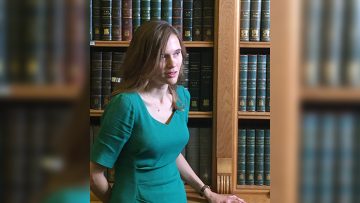
In anticipation of the upcoming election of the new ECM Committee, Shamia Sanjania, a co-opted member of the Committee, interviewed James Van Yperen, the current Events Leader, to discuss the role of the Committee.

Could you give a little introduction about yourself?
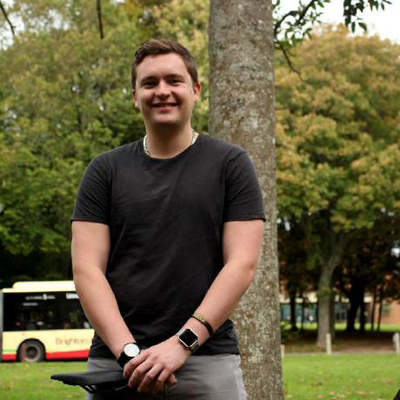
I am a post-doctoral researcher at the University of Sussex. I completed my PhD in 2020, about the time of the pandemic. I do research in Covid-19 modelling. I’ve been responsible for working as part of a modelling cell, a combination of universities, local authorities, and local NHS trusts. We’ve been doing forecasting work about Covid-19, in particular focusing on demand and capacity, like ward management, morgue management, and changes in public policy.
What are the ECM Committee roles?
We have the Chair and Designate, the Events Leader and Designate, the Engagement Leader, and the Diversity and Inclusion Leader, which is a new role at the upcoming election. The remainder are co-opted members. There are nine of us (eight this year). The Diversity and Inclusion Leader is a role for which people put themselves forward and the Committee chooses the most appropriate person. If you do want more information about that, then please look at our webpage, or get in touch with us (ecm@ima.org.uk). We are more than happy to speak about our roles.
What have you done in your role as Events Leader?
My main priority as the Events Leader is creating, planning, and running of events. Before I joined, there were one or two conferences per year. The ECM group would go around the country and have in-person conferences, and maybe also some Virtual Maths Teas.
What I wanted to do when I came to this role is to diversify our content, in the sense that online conferences can be difficult: long and time-consuming. We often had these in the evening or at the weekend. But not everyone likes doing maths in their free time!
So I thought about how we could make smaller, bite-sized, more manageable content. Some of the things that we are trying to do are podcasts and seminar series, as well as changing what our conferences will be about and collaborating with other societies. We are aiming to have a conference for teachers. We’ve started running Diversity Events. These are smaller and more contained.
Fortunately, while I’m responsible for most of the administration for these events, the rest of the Committee is available to help, so the workload is manageable. We set the details down in our Committee meetings, and there are others at these events to help me run them.
How do Maths Teas and conferences differ?
The IMA Maths Teas are usually one-hour meetings, with around 20 to 30 people. We’ve run two this year. One was on coding, around the birthday of Alan Turing in June. We ran another in August on post-PhD life: what to do if you want to go into academia, or into industry? It’s not a Q&A, but a conversation. People will join if they want to have a chat. That is very different from a conference.
The conferences that we run are fairly standard: we ask three or four academics from around the country, and hold it online, typically on a Saturday. Our other events are more ad hoc. The Diversity Event involved the IMA Diversity Champion, Snezana Lawrence FIMA, speaking, and then splitting the group into break-out rooms, discussing themes in diversity.
What is your favourite thing about the Committee meetings?
The majority of my position is thinking about events. Meetings can be a creative outlet to throw down ideas for events.
What are the benefits of a role on the Committee?
I thought about this question, and I came up with four things.
First is being sociable. I am shy; I still find talking to people within the mathematical community, especially academics or people in industry who are quite well known, daunting. Being in this role has given me cause to speak to these people. As a representative, I can approach them on behalf of this group. It has enabled me to be more sociable in events, because people have remembered me.
Second are organisational insights. I work at a university, and have done for a few years. When you work at a university, you think that you know a lot about life, but it turns out that universities work in a very different way from most organisations! In this role, I have learned how other organisations work. This certainly comes into play in emails, in when we can meet and when we discuss things. It is very easy as an academic to work silly hours and reply all the time: you are ‘always on’. For people who work for an organisation, like the IMA, it has helped me to be more concise.
Third is legacy. I hope events that I do, the ideas, and the innovation will leave a lasting footprint on this committee, and for ECMs as a whole. I’d like to hope that these could continue to go forward.
Finally, networking. As the Events Leader, I’ve had to talk to a lot of people, and I’ve met some amazing people. I think that they’ll remember me and I’ll certainly remember them. I’ll be calling on them in the future.
Reproduced from Mathematics Today, December 2022
Download the article, Interview with James Van Yperen AMIMA (pdf)