The South West and Wales Branch of the IMA and the Bristol Branch of the Royal Aeronautical Society (RAeS) jointly welcomed over 70 delegates to the Artificial Intelligence (AI) in Aerospace event at Aerospace Bristol on 10 October 2024. The event started with a reception where attendees could enjoy refreshments, network, and step onboard Concorde; followed by two lectures on AI in Aerospace Bristol’s main lecture theatre.
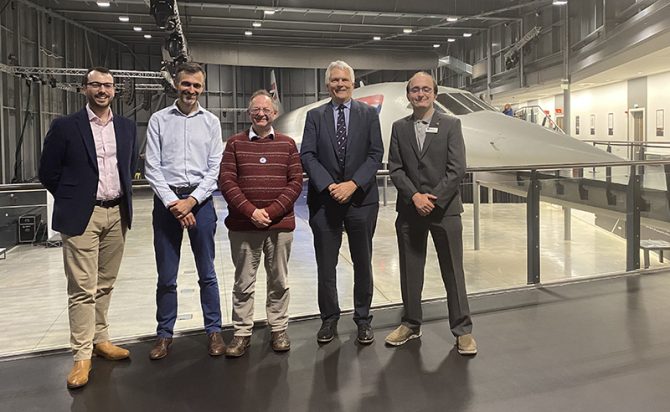
Prior to the lectures, I welcomed attendees in my roles as both IMA South West and Wales Branch Chair and RAeS Bristol Branch Young Person’s Representative. I highlighted the deep connection between mathematics, computer science and aerospace through the roles they played to enable Concorde to be the world’s first Fly-By-Wire airliner and how this laid the foundations for modern aircraft control systems. I also paid tribute to Sir James Lighthill FRS (1924–1998) in what would have been his centenary year, highlighting contributions made by him to the three areas.
Professor Chris Budd OBE CMath FIMA of the University of Bath then gave the talk Can you Tell a Mathematician from a Fish? Chris first introduced the basic ideas that underpin artificial intelligence and explained what a neural net is. He then explored the mathematics that underpins them, how they are trained, and enlightened attendees as to why they make mistakes.
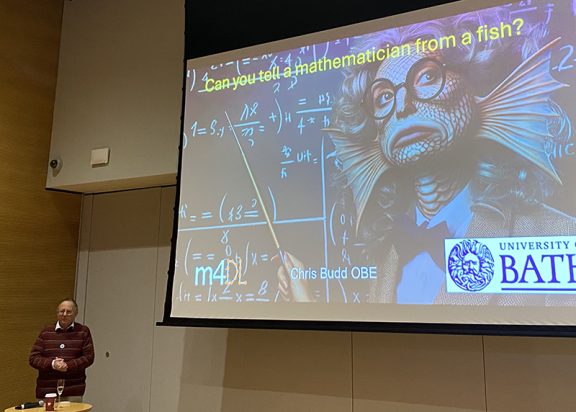
Chris then discussed different generative artificial intelligence methods such as autoregressive methods used by ChatGPT, and generative adversarial nets (GANs) used in weather forecasts. He concluded by presenting the threats posed by generative artificial intelligence, such as deepfake images, and how the fast Fourier transform algorithm can be used to identify them.
Dr Xavier Bertrand of Airbus then gave a talk titled Deep Generative Models in Aircraft Aerodynamics. Xavier first introduced how Airbus uses deep generative models such as GANs to make aerodynamic predictions using sparse wind tunnel test data.
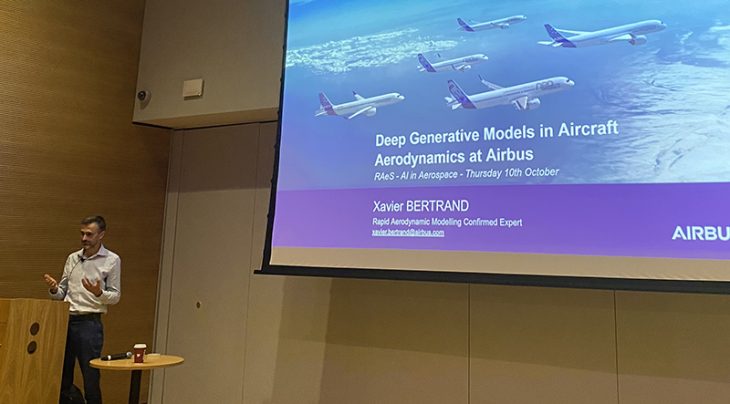
Following this he presented how well trained GANs can make aerodynamic predictions to account for changes in wing design, or the inclusion of features such as ailerons, over 99% quicker than traditional CFD. This is achieved by use of pressure scaling, where the GAN is provided with a baseline pressure map and scales this to account for the changes.
Xavier concluded by explaining the challenges of using CAD geometry with artificial intelligence and presented methods to overcome these such as graph neural nets and implicit neural representations.
Feedback from attendees at the event was universally positive. Martin Cooper of Rolls-Royce Plc whose team specialises in artificial intelligence provided the following comment:
The AI in Aerospace event was a fantastic opportunity to learn more within the sphere of AI. The first talk gave an appreciation of the underlying mathematics within AI which was complemented in the second talk by a deeper dive into the techniques being developed within industry. The event also enabled dialogues between academics and industry partners which has the potential to lead to future collaboration. Thank you for organising a fascinating and well run event.
The event was special in many ways, but most notably it was the relaunch event for both branches after they had fallen dormant during the Covid-19 pandemic. Both are now planning for the future and already have multiple exciting events scheduled for 2025.
Nicholas Brusby CMath MIMA
Rolls-Royce Plc
Reproduced from Mathematics Today, February 2025
Download the article, Artificial Intelligence in Aerospace Branch Event (pdf)