Matt Butler was awarded the IMA Lighthill-Thwaites Prize at the British Applied Mathematics Colloquium (BAMC), held at the University of Bath in April, for his work motivated by insect adhesion [1].
When picking up a drink resting on a coaster, you may sometimes find that the coaster remains stuck to the bottom of the glass. This occurs because there is fluid present in the gap between the two surfaces, perhaps due to condensation on the outside of a cold drink or from spillage. As you lift the glass, the surface tension of this liquid provides a force that is strong enough to hold the weight of the coaster.
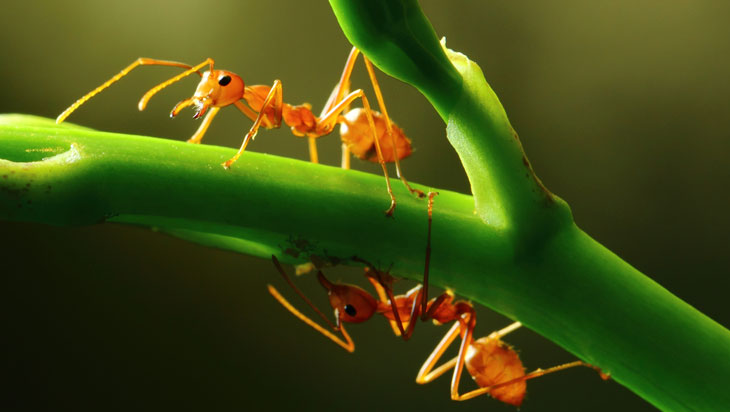
It is believed that the climbing ability of insects is aided by this effect, albeit at a smaller scale [2]. Insects are able to walk up walls and across ceilings, and have been observed holding over 100 times their own body weight whilst remaining adhered [3]. Looking closely beneath their feet, an oily fluid is found to be secreted, which is believed to help stick their feet to a wide variety of substrates via surface tension.
Surface tension can provide an adhering force because, at the free surface between two immiscible fluids, the competing chemical attractions between molecules give rise to a macroscopic jump in the pressure,  proportional to the curvature,
  , of the free surface, giving the Young–Laplace equation
(1) 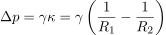
where  are the principal radii of curvature of the free surface, as shown in Figure 1. If the pressure inside the droplet is less than the external pressure,
  , hen the net effect will be to pull any two adjoining surfaces together – this is what holds the wet coaster onto the bottom of the glass, and is often called capillary adhesion.

A commonly used model for capillary adhesion is a droplet confined between two parallel, rigid plates separated by a distance  as shown in Figure 1. We can consider one of these plates as our ‘foot’, whilst the other is the substrate that we wish to stick to. The droplet has a known volume
  , a surface tension
  and the free surface meets the solids at a contact angle
  .
.
When in equilibrium, the droplet is at rest and its pressure is constant. This means that its free surface must have a constant curvature κ throughout, and the attractive force it provides is then
(2) 
where  is the wetted area of one of the surfaces.
If the droplet is much wider than it is tall, for example if  , then the radius of curvature around the droplet is much larger than that between the plates,
  and, moreover, we can approximate the free surface as an arc of a circle. We can then determine the curvature
  and the volume
  so that the adhesion force can be expressed as
(3) 
The adhesion force obeys an inverse square law with the gap width, , and so to increase our adhesion we simply need to bring our foot closer to the substrate.
However, observations of insects suggest that some species may have soft footpads. Could the reason for this be that having a deformable foot gives some improvement in adhesive capability?
To highlight the potential role of deformation on adhesion, we have replaced the previously rigid foot with a tense, deformable membrane that is clamped at its edges [1]. We adhere our foot to a rigid substrate using a fluid droplet, as before. Now, as well as control of the height at the clamp edge,  we can also choose the tension
  in the membrane.
To model this mathematically, we consider a force balance on the membrane and make some simplifying assumptions. For example, we assume that the droplet is wide and short again, and if the imposed tension is large enough then we can ignore any additional stretching or bending as it deforms. To determine the equilibria of the system for a given clamp height and tension, we find the shape of the membrane such that the droplet has a constant pressure.
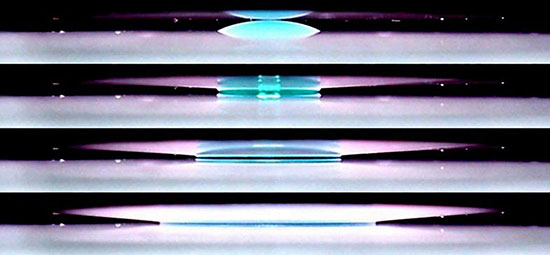
Calculating the equilibrium adhesion forces, we find that this deformable foot always performs better than an equivalent rigid foot (3). Loosely speaking, this is because of a positive feedback between deformation and surface tension. The surface tension pulls on the membrane, which causes it to deform more, squashing and spreading the drop as seen in Figure 2. The pressure in the droplet decreases (becoming more negative as the curvature does) and also acts over a larger area. This increases the pulling force, causing the membrane to deform more. This positive feedback can give a significant gain in adhesion compared to the rigid case (3).
In certain circumstances we find an increase in the adhesion force of orders of magnitude. To get this effect, the surfaces must be brought sufficiently close together or the tension must be relaxed (i.e. or is decreased).
The control of two independent parameters, and , allows us to consider different strategies to adhere and detach. Strong adhesion can be achieved by simply lowering the sheet, for example, but to detach we might prefer to increase the tension, performing a peeling-like action away from the substrate.
The strong adhesion and extra control of this deformable foot are excellent starting points for making a real-life adhesive system. However, experimental investigation with a lab-scale model showed that, when picking up loads, adhesion was only maintained if given a sufficient amount of time to adhere. We suggest that this is because of the formation of a fluid dimple beneath the membrane. Our model shows that the fluid resists being pushed radially outwards as the membrane is pulled downwards, and eventually must be squeezed out slowly through a narrow gap. This slows the progress to equilibrium.
Despite this caveat, the significant increase in adhesion compared to the rigid case suggests that deformable capillary adhesives are a fruitful area for further study. Taking inspiration from insects, we have found an interesting way to improve upon the regular rigid capillary adhesion. We hope that further bio-inspired studies can lead to advancements in the world of adhesion science.
Matthew Butler
University of Oxford
References
- Butler, M., Box, F., Robert, T. and Vella, D. (2019) Elasto-capillary adhesion: effect of deformability on adhesion strength and detachment, Phys. Rev. Fluids, vol. 4, no. 3, p. 033601.
- Dirks, J.H. (2014) Physical principles of fluid-mediated insect attachment – shouldn’t insects slip? Beilstein J. Nanotechnol., vol. 5, pp. 1160–1166.
- Dirks, J.H. and Federle, W. (2011) Fluid-based adhesion in insects: principles and challenges, Soft Matter, vol. 7, pp. 11047–11053.
Reproduced from Mathematics Today, August 2019
Download the article, Sticking with Droplets: How Having a Soft Foot Can Improve Capillary Adhesion (pdf)