In our ‘Meet a Member’ series, Mathematics Today Editorial Board Member Rob Ashmore CMath CSci FIMA interviews Emma Bowley CMath MIMA. Emma is a mathematician at the Defence Science and Technology Laboratory (Dstl), where she led a group for Dstl’s maths community. She is also an assessor for the Data Science Professional Certification. Emma has recently completed a three-year term as an elected member of IMA Council and has also served on the Institute’s committee supporting mathematicians working in business, industry and government.
What is your relationship with maths?
My relationship with maths began as a small child, an obsession with counting everything and looking for patterns. Perhaps I missed my calling to work for the Office for National Statistics (ONS), as my favourite pastime on car journeys was keeping tallies of cars on the clipboard my dad gave me. As I grew up, I loved maths at school and often took the opportunity to do additional work as I found it fascinating, like solving puzzles (another passion of mine). I loved my Maths degree with the Open University and began to see maths as a fantastic landscape that I was starting to (and have continued to) explore.
How do you use maths at work?
Maths has been vital to my role as a civil servant. A key example I often use is the importance of statistical design and analysis in experiments and surveys. It’s crucial to do this well to make sure that the evidence provided is robust so that our stakeholders can make informed, evidence-based decisions. That also means being clear about uncertainty and assumptions! More broadly, I think the maths-related skills I have developed have given me wider skills when it comes to being able to think analytically and spot patterns. There are so many patterns to be found in the wild, and spotting these can help to find new opportunities to apply mathematics.
How does your IMA membership and CMath benefit you?
My chartership journey was a brilliant activity for helping me to develop as a mathematician as the framework helped me to round out my profile. I find telling people I’m a Chartered Mathematician really gets them interested and is a great way to start a conversation about how maths can help with their projects. I have been incredibly lucky to be elected to be part of the IMA Council. This was a brilliant experience, not just professionally, but also for the opportunity to meet so many lovely people who give their time to make the IMA what it is. I’d really recommend getting more involved, as being part of a committee gives you the chance to shape the IMA and grow your networks with wonderful colleagues.
What are two big maths ideas that inspire you?
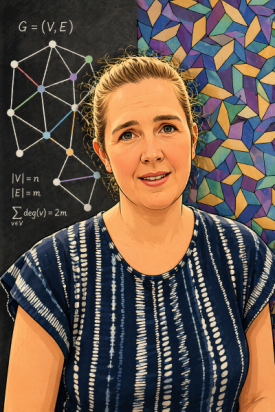
One area of maths that I have worked on since my graduation is graph theory. I didn’t know anything about it when I was first given a task to look at it. The way it represents the relationships between entities and the maths that this can open up is endlessly fascinating to me.
Another that really grabbed me was the idea of aperiodic tiling presented by Matt Parker in his IMA–LMS Christopher Zeeman Medal lecture. It can feel quite abstract, but then later I heard how aperiodic groups can be used to devise new metamaterials. I find this inspiring because it shows how mathematicians’ fascination with what can seem like very abstract problems can lead to advances in critical technologies.
How can we improve people’s perceptions of mathematics?
For me a very important point is to show the diversity of the mathematical landscape. The maths people experience at school is just one small fraction of the maths that exists (or could exist!). I love talking to people who say they didn’t ‘get’ maths and showing them some of the other areas of maths that I work on that they never got to see at school. Different terrains in the landscape can be better for different people! I love the work of Eugenia Cheng, who has written several interesting books on maths. She has shown that artists can have a great affinity for some deeply complex topics, like her own specialism of category theory, even if they didn’t think they were any good at maths.
How can we better educate and prepare mathematicians for the future?
I think it’s important to reassure people that having questions is a good thing. Although being able to accept mathematical facts is useful for passing exams, there is a whole world of maths that is opened up by asking questions. There’s a perception that mathematics is rigid with fixed answers; that fixed proofs exist and that there is a ‘right’ way to do things. When people come with a new perspective, it can reveal a new insight on a problem or an idea. There have been wonderful stories over the years when people have found new ways to prove established results that people had never thought of before. Artificial intelligence may be able to help answer questions and produce proofs, but the human imagination’s ability to ask questions feels like the thing that will help us open up currently undiscovered areas in the maths landscape.
Can you recommend a maths book?
I have to recommend A Little History of Mathematics by Snezana Lawrence FIMA. It’s so interesting to see how mathematics developed through history, and how it sprang up in different places and cultures. It’s a lovely book and with nice bite-size chapters, making it great to have in your bag when you get ten minutes to snatch a little reading time on a busy day!
Crown Copyright © 2026 Dstl. This information is licensed under the Open Government Licence v3. The views and opinions expressed herein are those of the author and do not necessarily reflect those of the Defence Science and Technology Laboratory.
Reproduced from Mathematics Today, August 2026
Download the article, Meet a Member: Emma Bowley CMath MIMA (pdf)