Westward Ho! What Happened Next?
Reflecting on four years of writing these West Country musings and inspired by a favourite round of a long-running TV quiz show, Alan Champneys tries to answer the question: ‘What happened next?’ That is, what is the next chapter in some of the stories that have been featured so far? [latexpage] I am a huge fan of both sport and quiz shows on television. Combining the two, since childhood one of my favourite programmes has been the BBC's A Question of Sport. Most eagerly awaited each week was the round where some perfectly innocuous sporting action would unfold, only for the footage to freeze and the contestants asked: ‘What happened next?’ Bizarre goalkeeping errors in football provided a rich vein of material, as did comedy run-outs in cricket. But, in a sense, to the connoisseur, the innocuous back pass or the forward prod into the unguarded cover region become natural portents of disaster. The best ones involve the truly unexpected: the catastrophic failure of an everyday piece of equipment, the violent consequences of an unlucky ball bounce or, my personal favourite, the irresponsible behaviour of a member of the animal kingdom. I have been writing these Westward Ho!'s for almost four years, and I believe this will be the 20th. So I thought it might be a good time to pause and reflect. Each piece is a stream of consciousness about whatever happens to interest me at the time. I write in a bit of a rush, and errors inevitably enter – I thank those readers who have written in with corrections. To me there is a live element; as I start writing, I never know quite where it is going to end up. It is as if the publication deadline acts as a freeze frame on the narrative. For most of the stories, there has been a natural ending point. For others though, it is as if the action has continued and what happened next has taken an unexpected turn.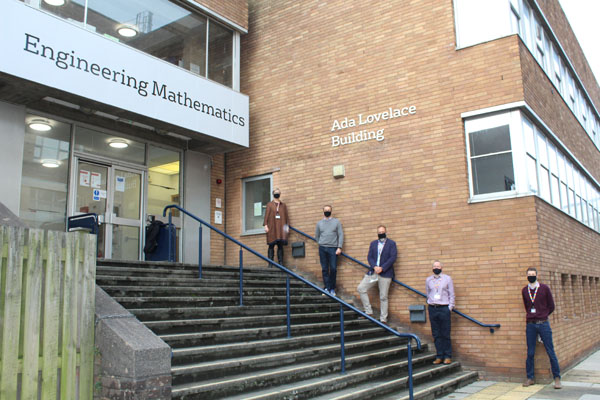 The piece ‘Pride and Prejudice’ [1] from August 2020 seemed to resonate with the rightful focus in our community on under-represented communities. As I was writing, my department at the University of Bristol was in the process of moving to a different building, the newly refurbished former Maths building on University Walk. The university now has a policy that buildings should no longer be named after the function they contain. The Engineering Maths Department was given the chance to propose names for its new home. A committee was formed to draw up a short list, which was then put to a vote of all staff and students.
In a tight contest, the name chosen was the Ada Lovelace Building. The other two names on the short list were Bristol-based 19th century engineer and inventor Sarah Guppy and Katherine Johnson, the NASA mathematician featured in the book and film Hidden Figures. But why did we choose an all-female short list?
If I am being honest, while going along with the need for greater diversity in our profession, it is only recently that I have had my own perceptions challenged. I know few people in our community who are overtly racist, sexist or elitist. But, it is the little things that matter.
As an early career academic, I recall my imposter syndrome being exacerbated by the corridor in our faculty building, which prominently displayed monochrome smiling photographs of former professors. Given that all were white males, presumably men of privilege, how much more would such imagery have made women feel that they do not belong? Or, for that matter, those from the BAME, LGBTQ+ or working class communities?
It would seem there is no single ‘silver bullet’ for achieving true gender balance, the widespread acceptance of ethnic, sexual and neural diversity, or the correction of elitist mentalities. It is not a question of quick actions. Lasting change will doubtless require a sustained cultural shift, and for us all to think about our unconscious biases and the subliminal messages we transmit.
Why is this important? There are those, including some of our elected politicians, who have started a backlash against modern ‘woke’ values. I make no comment on politics, but from an IMA perspective, even if one took a hard-nosed attitude, clearly in the current data-rich, ‘post-truth’ world, society needs more mathematical scientists, at all levels. In my view, to face the challenges ahead, we simply cannot afford to ignore the potential talent of 50% or more of the next generation.
Despite broadening the discussion to wider forms of prejudice, I do not want to forget the remarkable life of Ada Lovelace and other pioneering women.
Just as I was writing this, I got a nice email from Ursula Martin, from the University of Oxford, who, you may recall from [1], has published, along with colleagues, historical research that unpicks Ada's mathematical contributions. Perhaps, other historians of mathematics will be drawn to Ada's work, which Ursula helpfully informs me is now available as an archive held by the Clay Institute [2].
The history of mathematics and mechanics has played a role in many of these Westward Ho!'s. In the piece on the bridges of Bristol [3] from December 2019, I introduced a modern-day variant of the famous bridges of Königsberg problem, the solution to which, as ‘everybody knows’, led Leonhard Euler to introduce discrete topology, otherwise known as graph theory. Except, it seems, this is not quite true.
In March, just before the lockdown, I was honoured to be invited to give one of the Oxford University Mathematics Department's monthly outreach lectures. Robin Wilson, the Open University affiliated historian of mathematics, had left an envelope for me with a reprint by him and Brian Hopkins [4] that relates to the bridges of Königsberg. I am sorry to say that despite glancing at the contents, I was pre-occupied with my hastily prepared lecture on the topic of misunderstandings about the instability of London's Millennium Bridge (a topic that will doubtless form the subject of a future Westward Ho!). The paper remained unread, in my (makeshift) home office in my (redundant) work bag, until the late summer. Only then did I notice Robin's note to accompany the paper, which had some nice words of explanation.
In work that won them the 2005 George Pólya Award from the Mathematical Association of America, Hopkins and Wilson carefully analysed Euler's solution to the bridge problem. In his 1736 paper, Euler states three results [4, pp. 205–206]:
The piece ‘Pride and Prejudice’ [1] from August 2020 seemed to resonate with the rightful focus in our community on under-represented communities. As I was writing, my department at the University of Bristol was in the process of moving to a different building, the newly refurbished former Maths building on University Walk. The university now has a policy that buildings should no longer be named after the function they contain. The Engineering Maths Department was given the chance to propose names for its new home. A committee was formed to draw up a short list, which was then put to a vote of all staff and students.
In a tight contest, the name chosen was the Ada Lovelace Building. The other two names on the short list were Bristol-based 19th century engineer and inventor Sarah Guppy and Katherine Johnson, the NASA mathematician featured in the book and film Hidden Figures. But why did we choose an all-female short list?
If I am being honest, while going along with the need for greater diversity in our profession, it is only recently that I have had my own perceptions challenged. I know few people in our community who are overtly racist, sexist or elitist. But, it is the little things that matter.
As an early career academic, I recall my imposter syndrome being exacerbated by the corridor in our faculty building, which prominently displayed monochrome smiling photographs of former professors. Given that all were white males, presumably men of privilege, how much more would such imagery have made women feel that they do not belong? Or, for that matter, those from the BAME, LGBTQ+ or working class communities?
It would seem there is no single ‘silver bullet’ for achieving true gender balance, the widespread acceptance of ethnic, sexual and neural diversity, or the correction of elitist mentalities. It is not a question of quick actions. Lasting change will doubtless require a sustained cultural shift, and for us all to think about our unconscious biases and the subliminal messages we transmit.
Why is this important? There are those, including some of our elected politicians, who have started a backlash against modern ‘woke’ values. I make no comment on politics, but from an IMA perspective, even if one took a hard-nosed attitude, clearly in the current data-rich, ‘post-truth’ world, society needs more mathematical scientists, at all levels. In my view, to face the challenges ahead, we simply cannot afford to ignore the potential talent of 50% or more of the next generation.
Despite broadening the discussion to wider forms of prejudice, I do not want to forget the remarkable life of Ada Lovelace and other pioneering women.
Just as I was writing this, I got a nice email from Ursula Martin, from the University of Oxford, who, you may recall from [1], has published, along with colleagues, historical research that unpicks Ada's mathematical contributions. Perhaps, other historians of mathematics will be drawn to Ada's work, which Ursula helpfully informs me is now available as an archive held by the Clay Institute [2].
The history of mathematics and mechanics has played a role in many of these Westward Ho!'s. In the piece on the bridges of Bristol [3] from December 2019, I introduced a modern-day variant of the famous bridges of Königsberg problem, the solution to which, as ‘everybody knows’, led Leonhard Euler to introduce discrete topology, otherwise known as graph theory. Except, it seems, this is not quite true.
In March, just before the lockdown, I was honoured to be invited to give one of the Oxford University Mathematics Department's monthly outreach lectures. Robin Wilson, the Open University affiliated historian of mathematics, had left an envelope for me with a reprint by him and Brian Hopkins [4] that relates to the bridges of Königsberg. I am sorry to say that despite glancing at the contents, I was pre-occupied with my hastily prepared lecture on the topic of misunderstandings about the instability of London's Millennium Bridge (a topic that will doubtless form the subject of a future Westward Ho!). The paper remained unread, in my (makeshift) home office in my (redundant) work bag, until the late summer. Only then did I notice Robin's note to accompany the paper, which had some nice words of explanation.
In work that won them the 2005 George Pólya Award from the Mathematical Association of America, Hopkins and Wilson carefully analysed Euler's solution to the bridge problem. In his 1736 paper, Euler states three results [4, pp. 205–206]:
- If there are more than two areas to which an odd number of bridges lead, then such a journey [that crosses each bridge precisely once] is impossible.
- If however, the number of bridges is odd for exactly two areas, then the journey is possible if it starts in either of those two areas.
- If, finally, there are is no area to which an odd number of bridges lead, then the required journey can be accomplished starting from any area.
although the lift is zero when [viscosity] $\nu = 0$ (by D'Alembert) it is $\rho U \Gamma$ as $\nu \searrow 0$. … this lift is due to viscosity but not dependent on the size of viscosity. It is a remarkable illustration of the nonuniform convergence of the solution of the Navier–Stokes equations as $Re\to\infty$ that a boundary layer of thickness $10^{-1}$