After the end of one academic year, and in anticipation of the start of another, particularly as many employers look towards graduate careers fairs in the autumn and the arrival of new recruits, there is a timely opportunity to review your career plans: How have they advanced? What plans should be made for the future? How are those most readily achieved? In that context, the IMA, as a professional body and learned society, offers much support, especially to those now embarking upon their careers, or who have only recently done so. But it is natural for early career members to wonder how the IMA can help their careers and ask: What has the IMA done for me?
Fundamental to that support is being part of a community that shares common approaches to work, values, and skills, as well as intercourse through events like Virtual Maths Teas (VMTs) and through the Institute’s publications (like Mathematics Today!). Mathematicians are naturally to be found in the mathematics departments of universities, but they frequently also work in other departments, such as physics, computing, and engineering. Outside academia, the term ‘mathematician’ is not always as prominent as it ought to be, but those who merit it are to be found as engineers in aerospace, as quantitative analysts in finance, as programmers and statisticians almost everywhere, and in many other roles. Planting the seed that will – hopefully – lead new minds into all of these occupations are teachers.
Scattered across so many institutions and sectors, it is vital that there should be some link to draw together those who share the mindset and approach that our discipline instils, and to preserve a common identity as mathematicians across many multi-disciplinary environments, including through exposure to the rest of that community.
Given the breadth of its membership and the variety of its activity, there is naturally great scope for networking in the Institute. Within individual branches, events bring together local members from neighbouring universities and companies. Equally importantly, local and national conferences unite those in similar geographic areas, working on similar themes, or at a similar stage of their careers, such as the Early Career Mathematicians (ECM) Spring and Autumn Conferences. For those in industry, networking in this way gives access to new opportunities for interacting with clients, for access to training, and for acquiring new skills.
Training is an important part of the Continuing Professional Development (CPD) that the Institute promotes. Part of the training for any occupation, be it in industry or at a university, is learning, sharing, and following good practices in every approach to work. For mathematicians, programming is often one of the most important of those approaches. Mindful of this, the ECM Committee has, through recent events, prioritised programming. At recent VMTs on ‘Mathematics and Programming’ and ‘Skills in Industry for Early Career Mathematicians’, we have discussed matters of good coding style and conventions. Alongside other questions of sound professional practice, we expect to revisit this important topic at forthcoming VMTs.
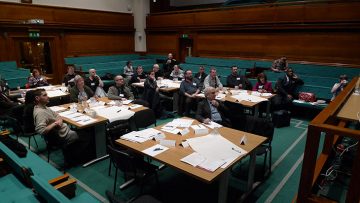
Both in schools and in universities, successful teaching is fundamental, and the most fruitful teaching methods are prized. Pedagogical practices and advice can be shared in a variety of ways. In Teaching Mathematics and its Applications: an International Journal of the IMA, educators have for many years published analyses of various teaching methods, but, particularly since the shift towards online communication and the upheaval of teaching purely online in the recent pandemic, many new platforms have emerged. Among these are online teaching conferences, which allow those at different institutions to share their ideas. As an example of this, the ECM Committee convened a conference on ‘Idea exchange: early career mathematicians and statisticians teaching in Higher Education’. We paid particular attention to the new technologies that have recently become common in teaching.
For many, accumulated training and the exchange of knowledge serve the purpose of obtaining Chartered Mathematician (CMath) or Chartered Scientist (CSci) status, or both, and the encouragement and insight of others is often a spur to do so. Having and applying for Chartership are both valuable in themselves.
For graduates who have recently left university, it offers something to work towards, particularly for those in industry, who might otherwise lack clear markers of progression. In addition, it provides another opportunity to reflect upon the knowledge and skills that you have gained so far in your career. Reflecting on those capabilities often reveals ‘standard gaps’ in professional development, and prompts the question of how best to fill them.
CMath status offers professional recognition in the field and an acknowledgement of having attained a certain degree of professional, as well as academic, competence. CMath is acknowledged and accepted by many employers, alongside other formal professional qualifications such as Chartered Engineer (CEng) status.
For those in teaching, Chartered Mathematics Teacher (CMathTeach) registration signifies an equivalent level of professional distinction, high standards, and individual commitment.
In light of the many advantages that Chartership brings, the ECM Committee strongly encourages early career mathematicians to seek it, and is currently exploring how it may be promoted, especially among students. Setting the goal of Chartership early provides a solid foundation to the formative stages of a career.
While Chartership is a goal predominantly oriented for those in industry, recognition by your peers is as important, if not more so, for those who remain within academia after their degrees. Success in the academic environment is based upon building and promoting a personal portfolio of research, crystallised in the form of publications. Sharing that work is possible in a number of ways. Recently, the ECM Committee started a series of webinars, in which young mathematicians are given a forum to present and discuss their work. Among those invited to do so are the winners of the Graham Hoare Prize, which is awarded each year for an excellent piece among the many written by ECMs for this annual competition, with the winning article published in Mathematics Today.
Similarly, the IMA Lighthill–Thwaites Prize is awarded for original early career research, within the scope of the IMA Journal of Applied Mathematics. At the British Applied Mathematics Colloquium (BAMC), the finalists present their work and the winner is announced. For numerical analysts, the Leslie Fox Prize is awarded for an outstanding contribution to that field by a researcher under 31 years of age.
With so many opportunities on offer, there are many choices to be made. For early career mathematicians, whose career paths are seldom fixed or clear-cut, these decisions are charged with additional potency. In order to help in these decisions, the Institute provides a variety of resources. Many often turn to the Maths Careers website, and careers and professional development are popular topics for VMTs. In addition to these, IMA Academic Representatives at each university serve as points of contact and can offer advice to students.
From the preceding examples, it is clear that the IMA offers much, both to early career mathematicians and to members more generally. Hence, perhaps the question should be: Am I taking advantage of all the IMA offers me?
Nicholas Brusby CMath MIMA, Jack Reid MIMA
and James Van Yperen AMIMA
Early Career Mathematicians Committee
Reproduced from Mathematics Today, August 2023
Download the article, Early Career Opportunities in the IMA (pdf)