Following the crowd
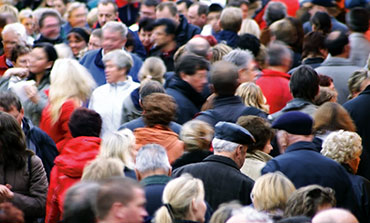 Football matches, pilgrimages and political protests all have one thing in common: people. Lots of them. Whenever people gather in large numbers, whether it's to pray to sporting deities or wailing walls, there is always the potential of danger. The main aim of the organisers in such situations is to keep people safe.
London's annual New Year celebrations are just one example of where the mathematics of crowd dynamics is used - up to 200,000 people can gather on the banks of the Thames to witness the fireworks first-hand, as Big Ben puts an end to the past year. However, there is only a fixed amount of space in the designated viewing areas - they can only fit a pre-determined number of spectators.
This means that once the viewing areas are full no-one else can get in. Without careful planning this would lead to a large volume of people, many of them frustrated, stuck in the feeder channels. They would be unable to get into the viewing areas, but unable to head back due to the large number of people behind them. That is recipe for potential danger.
Instead, the situation is carefully controlled using a combination of crowd sampling and mathematical modelling. A important mathematical tool is the event's likely arrival profile - a graph showing the number of people likely to arrive over time. Different kinds of events have typical arrival profiles of different shapes. Knowing the likely mathematical pattern of arrivals is a key piece of information. For example, an all
Football matches, pilgrimages and political protests all have one thing in common: people. Lots of them. Whenever people gather in large numbers, whether it's to pray to sporting deities or wailing walls, there is always the potential of danger. The main aim of the organisers in such situations is to keep people safe.
London's annual New Year celebrations are just one example of where the mathematics of crowd dynamics is used - up to 200,000 people can gather on the banks of the Thames to witness the fireworks first-hand, as Big Ben puts an end to the past year. However, there is only a fixed amount of space in the designated viewing areas - they can only fit a pre-determined number of spectators.
This means that once the viewing areas are full no-one else can get in. Without careful planning this would lead to a large volume of people, many of them frustrated, stuck in the feeder channels. They would be unable to get into the viewing areas, but unable to head back due to the large number of people behind them. That is recipe for potential danger.
Instead, the situation is carefully controlled using a combination of crowd sampling and mathematical modelling. A important mathematical tool is the event's likely arrival profile - a graph showing the number of people likely to arrive over time. Different kinds of events have typical arrival profiles of different shapes. Knowing the likely mathematical pattern of arrivals is a key piece of information. For example, an all