On a crisp, dark evening it is possible to see three thousand stars twinkling across the sky. Far from far-off specks of light, they are cosmic nuclear reactors busy devouring the matter in their cores to produce the energy we see as starlight. Bringing their method of energy production, called fusion, down to Earth would go a long way to solving the planet's growing energy crisis.
The population of the Earth has rapidly grown in recent decades, hitting seven billion for the first time in 2011; by 2050 it is predicted to reach 9.2 billion. More people means a greater strain on energy resources. With the demand rising, and the supply of fossil fuels decreasing, an energy shortfall is expected to develop. UK mathematicians are working alongside physicists in an attempt to perfect the fusion power stations that may one day plug the gap; 20% of the world's electricity could be generated from fusion by 2100.
Their work has already achieved Earth-bound fusion: in 1997 the Joint European Torus (JET) machine, housed in the Oxfordshire- based Culham Centre for Fusion Energy, successfully produced sixteen megawatts of fusion power. This is short of the amount required to supply energy to power grids, but it demonstrated it was possible to mimic the Sun and stars.
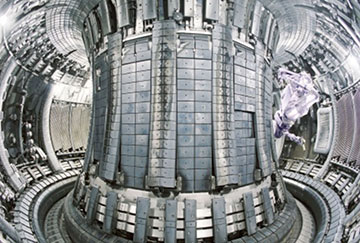
JET is a “tokamak”, a word that starts to betray the way it works: it is derived from the Russian for “toroidal chamber with magnetic coils”. A 100 cubic metre doughnut
 On a crisp, dark evening it is possible to see three thousand stars twinkling across the sky. Far from far-off specks of light, they are cosmic nuclear reactors busy devouring the matter in their cores to produce the energy we see as starlight. Bringing their method of energy production, called fusion, down to Earth would go a long way to solving the planet's growing energy crisis.
The population of the Earth has rapidly grown in recent decades, hitting seven billion for the first time in 2011; by 2050 it is predicted to reach 9.2 billion. More people means a greater strain on energy resources. With the demand rising, and the supply of fossil fuels decreasing, an energy shortfall is expected to develop. UK mathematicians are working alongside physicists in an attempt to perfect the fusion power stations that may one day plug the gap; 20% of the world's electricity could be generated from fusion by 2100.
Their work has already achieved Earth-bound fusion: in 1997 the Joint European Torus (JET) machine, housed in the Oxfordshire- based Culham Centre for Fusion Energy, successfully produced sixteen megawatts of fusion power. This is short of the amount required to supply energy to power grids, but it demonstrated it was possible to mimic the Sun and stars.
JET is a “tokamak”, a word that starts to betray the way it works: it is derived from the Russian for “toroidal chamber with magnetic coils”. A 100 cubic metre doughnut
On a crisp, dark evening it is possible to see three thousand stars twinkling across the sky. Far from far-off specks of light, they are cosmic nuclear reactors busy devouring the matter in their cores to produce the energy we see as starlight. Bringing their method of energy production, called fusion, down to Earth would go a long way to solving the planet's growing energy crisis.
The population of the Earth has rapidly grown in recent decades, hitting seven billion for the first time in 2011; by 2050 it is predicted to reach 9.2 billion. More people means a greater strain on energy resources. With the demand rising, and the supply of fossil fuels decreasing, an energy shortfall is expected to develop. UK mathematicians are working alongside physicists in an attempt to perfect the fusion power stations that may one day plug the gap; 20% of the world's electricity could be generated from fusion by 2100.
Their work has already achieved Earth-bound fusion: in 1997 the Joint European Torus (JET) machine, housed in the Oxfordshire- based Culham Centre for Fusion Energy, successfully produced sixteen megawatts of fusion power. This is short of the amount required to supply energy to power grids, but it demonstrated it was possible to mimic the Sun and stars.
JET is a “tokamak”, a word that starts to betray the way it works: it is derived from the Russian for “toroidal chamber with magnetic coils”. A 100 cubic metre doughnut